
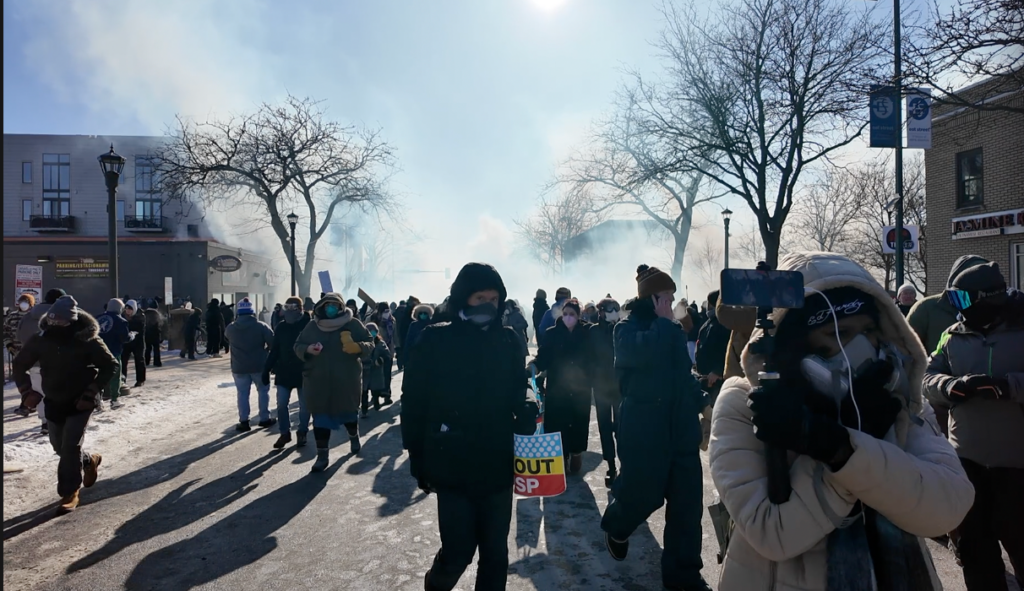
After months of a series of hardline enforcement actions intended to demonstrate toughness on one of the Republican Party’s signature issues, the White House has been forced to retreat in the face of a strong public backlash in the United States—particularly after two Americans were shot and killed in Minneapolis.
Yet the political calculus that compelled the Trump administration to change course is a double-edged sword. If the government’s extreme stance on cracking down on illegal immigration appears to soften, it risks alienating the hard-core “MAGA” base, a loss of support the Republican Party can ill afford at this moment. But failing to soften risks pushing away moderate Republicans, independent voters, young voters, and Latino voters—groups that in principle support immigration enforcement but dislike how it has been carried out.
A Fox News poll released last week showed that 52 percent of voters said they would support the Democratic candidate for the House of Representatives in their district—the highest level of support for either party in that poll since October 2017. A Wall Street Journal poll conducted in January found voters almost evenly split on Trump’s deportation policies, but a majority opposed deploying ICE in U.S. cities. Conducted between the killings of Goode and Pretty, the survey found that 54 percent of voters believed ICE’s deployment had “gone too far,” 24 percent said it was “not tough enough,” and 21 percent said it was “about right.”
A Reuters/Ipsos poll conducted before and after Pretty’s death and released on Monday showed Trump’s approval rating on immigration falling to its lowest point since his return to the White House. Fifty-three percent of Americans said they disapproved of his immigration policies, while only 39 percent approved. By contrast, as recently as February 2025, 50 percent of Americans still expressed support.
For Trump, a crushing defeat in the midterm elections would mean that the final two years of his administration would be consumed by Democratic obstruction, investigations, and possibly impeachment proceedings, rather than advancing his own agenda—an outcome the White House is desperate to avoid. The result has been a rare moment of vulnerability on Trump’s strongest issue. It has not only exposed fissures within the Republican Party and sharpened Democratic attacks, but also forced the White House into a defensive posture it never anticipated.
Some Trump allies insist that Republicans should not shrink from an issue on which they hold their greatest advantage, blaming the current predicament on Democrats. Polling experts say immigration has been one of Trump’s most successful policy areas, and that what is striking now is seeing Republicans forced to defend themselves on an issue they should not have to defend. Political analysts warn that, ultimately, Trump faces the risk of turning immigration—once a “trump card”—into a liability for Republicans in the midterm elections. The nonpartisan Cook Political Report said Trump is giving Democrats an opportunity to “reclaim the narrative of ‘law and order.’” Analysts argue that immigration is “no longer the strength it once was” for Trump, and that his enforcement policies may “push more independent voters into the Democratic camp.”
Last week, the Trump administration appeared overwhelmed as it grappled with the political fallout from the killing of Minnesota resident Pretty. Even some Republicans who are usually loyal to Trump openly criticized the president, while others called for the removal of senior officials—particularly Homeland Security Secretary Noem. The White House quickly softened its rhetoric, saying future deportation efforts would shift toward more targeted actions.
Some Trump allies worry that overly aggressive strategies could alienate key swing voters in November, and argue that Republicans should instead focus on criminal arrests, public safety, and the Trump administration’s achievements in securing the southern border—issues that poll better across voter groups. At the same time, some of the harder-line elements of Trump’s base acknowledge that the highly visible, attention-grabbing “optics” of immigration enforcement have indeed created vulnerabilities. Such loud, muscular displays invite too much confrontation, some Republicans say; it would be better to act more quietly while deporting just as many people—less spectacle, less showboating.
Party insiders also warn, however, that any move perceived as a “retreat” could further demoralize the base, which is already uneasy about economic conditions. Trump’s core supporters are, on the whole, not affluent, and if immigration is taken off the table as well—if they no longer believe the president is serious about the issue—it could be disastrous.